
Why Hourly Billing Hurts Immigration Lawyers
Bottom Line Up Front:
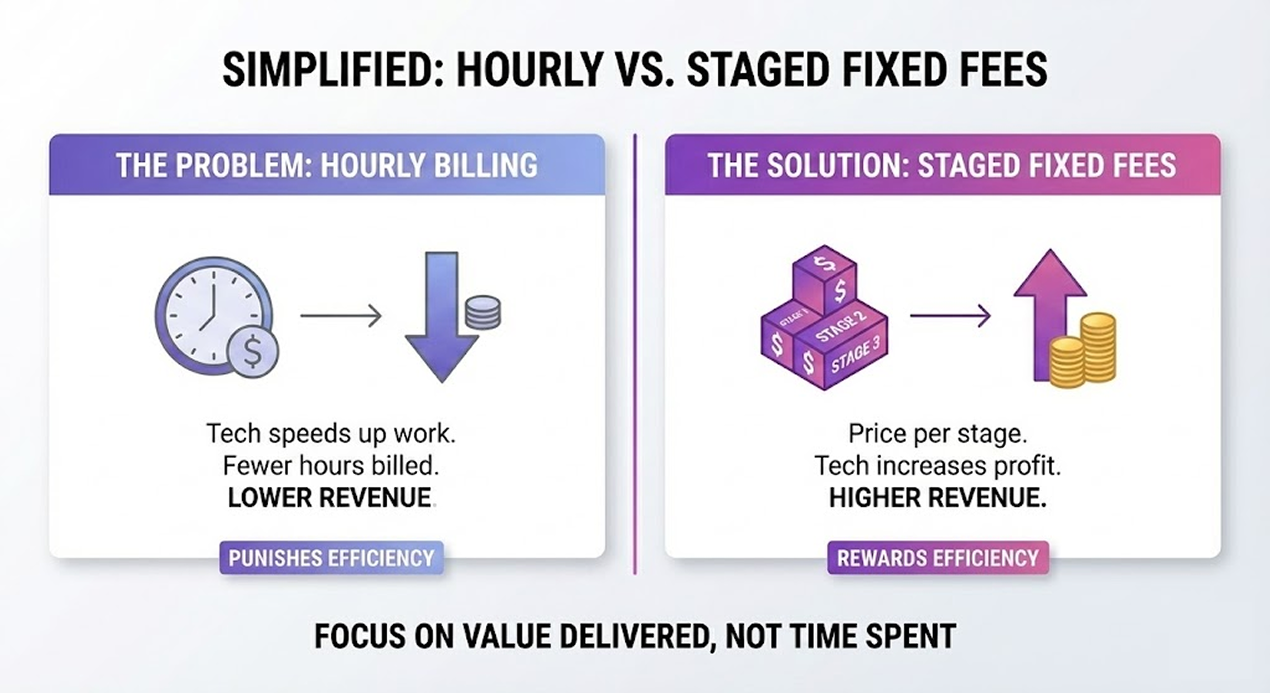
If you bill by the hour, technology is your enemy. Every time you use automation to finish a task faster, you lose revenue. To build a profitable modern immigration firm, you must decouple your income from your time. The solution is not just "flat fees." It is a strategic mix of Staged Fixed Fees.
The "Efficiency Tax" of Hourly Billing
For decades, lawyers have sold their time. This works for complex litigation, but it is broken for immigration law.
Immigration work is becoming process-driven. We now have software like Clio or Docketwise that can auto-fill forms¹, and analysis tools like Grella to instantly search through countless documents with answers you can trust through citations you can easily double check to see where the answers come from. These tools make you faster.
Stop Wasting Hours on Documents
Upload once, AI remembers forever. Get answers with citations you can verify instantly.
Here is the problem:
- Old Way: You spend 5 hours drafting a visa application. You bill 5 hours. You make $1,500.
- New Way: You use tech to do it in 1 hour. You bill 1 hour. You make $300.
By being efficient, you lost $1,200. This is the "Efficiency Tax." This phenomenon helps explain why hourly billing realization rates have historically stagnated around 80-85%, as firms often write down time that feels "too efficient" or "too long."²
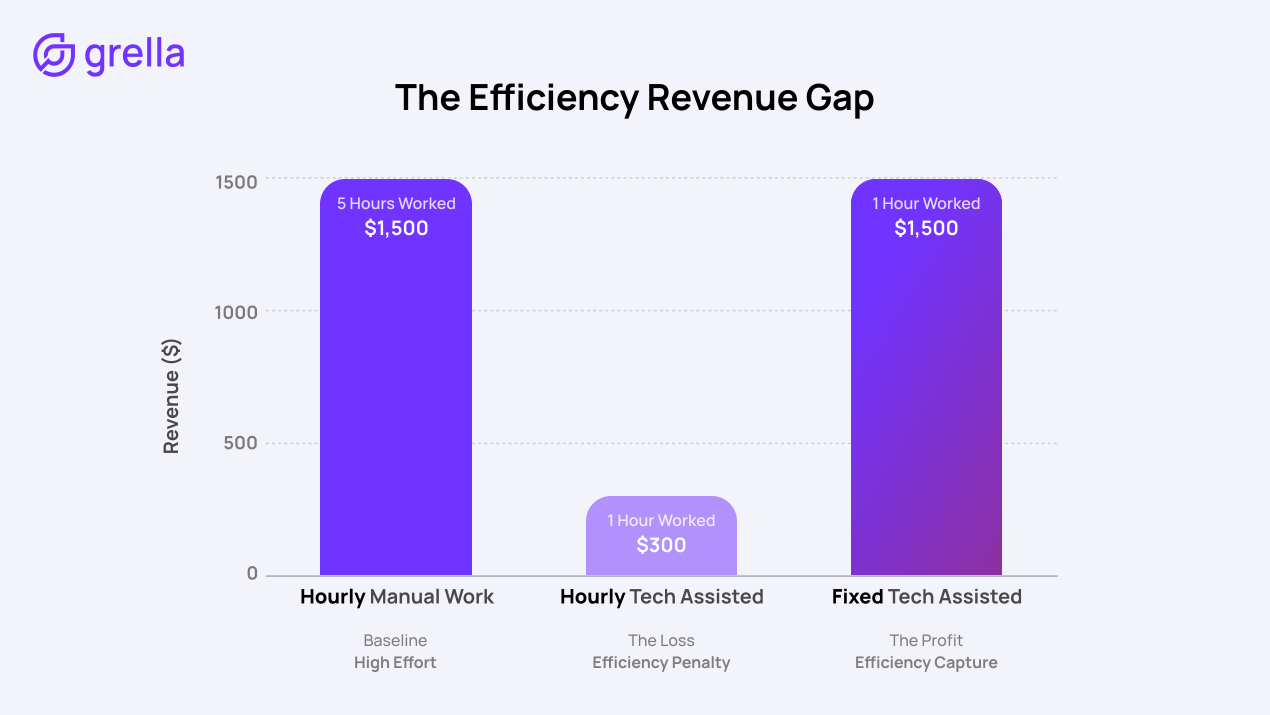
Hourly billing punishes you for being good at your job. To capture the value of your speed, you must switch to a fixed price model.
Definitions: "Flat" vs. "Fixed" (They Are Not the Same)
Many firm owners use these terms interchangeably. They are different. The difference is risk.
1. The Flat Rate (The "All-In" Gamble)
This is a single price for the entire matter, start to finish.
Example: "$4,000 for a Partner Visa / Green Card application."
The Risk: You carry 100% of the risk. If the case gets complicated, you work for free.
2. The Fixed Fee (The Scoped Approach)
This is a set price for a specifically defined stage of work.
Example: "$1,500 for the Initial Filing Stage only."
The Risk: Shared. You are paid for a specific output. If the scope changes, the fee changes.
The Problem with Flat Rates
Flat rates are easy to sell. Clients love knowing the total number upfront. But "All-In" flat rates can destroy your profit margin.
Competitors like LegalZoom and Boundless have already anchored client expectations to low, flat rates (e.g., Boundless advertises Marriage Green Cards starting at flat rates significantly below full-service firm averages)³. If you try to compete with them on a simple "flat fee" without managing your scope, you will lose.
Imagine you quote a flat $5,000 for a spousal visa.
- Best Case: The case is clean. You finish in 10 hours. Your effective rate is $500/hour.
- Worst Case: The government issues a massive Request for Evidence (RFE in the US) or an s56 Request (in Australia).
Suddenly, you have to spend 20 extra hours responding to the government. You cannot bill for this extra time. Your effective rate drops to $166/hour. You are now working hard for very little profit.
The Verdict: Use "Staged" Fixed Fees
The best model for modern firms is the Staged Fixed Fee (also referred to as "Unbundled Legal Services" or "Limited Scope Representation"). This approach is increasingly supported by regulatory bodies as a way to increase access to justice while protecting attorneys, provided the scope is reasonable⁴.
Instead of charging one giant sum, break the case into 3-4 distinct stages. This protects your cash flow and your sanity.
A Typical Staged Model:
| Stage | Fee | Payment Trigger | Deliverable | Benefit |
|---|---|---|---|---|
| 1. Strategy & Assessment | $500 | Upfront at booking | Roadmap & Eligibility Check | Filters out "tire kickers" who aren't serious. |
| 2. Preparation & Drafting | $2,500 | Before work starts | Document Collection & Forms | You get paid for the heavy lifting before you file. |
| 3. Lodgement & Management | $2,000 | Before submission | Submission & Monitoring | Maintains cash flow during long wait times. |
Why Staged Fees Win:
- Better Cash Flow: You recognize revenue as you complete each stage. You don't have to keep thousands of dollars locked in a Trust Account (or IOLTA) for years⁵.
- Risk Protection: If the client disappears or the relationship breaks down after Stage 1, you aren't stuck with a mess. You were paid for Stage 1, and the contract ends there.
The "Scope Creep" Firewall
Fixed fees only work if you have strict boundaries. This is called a "Scope of Work."
If you don't define what is included, the client will assume everything is included.
Your Service Agreement must explicitly handle these three things:
- Government Requests: State clearly: "This fee covers routine processing. Complex responses to Government requests (like an RFE or NOID) trigger a separate fee."
- Material Changes: What if the client gets a criminal record or separates from their partner while the case is pending? This is a "Material Change." Your contract must say that new issues require a new fee.
- Communication Caps: Fixed fees are not an "all-you-can-eat" buffet of phone calls. Set a limit (e.g., "Includes 3 scheduled calls").
Advanced Strategy: The "Tiered" Offer
To truly scale, stop selling "legal services" and start selling "products."
Borrow a page from the software industry: Offer three tiers of service for the same visa. This utilizes the psychological principle of "Goldilocks Pricing" (or decoy pricing), which steers consumers toward a middle option while using a high-priced anchor to make standard prices feel more reasonable⁶.
- Silver (Standard): Full representation, standard communication speeds (48-hour reply).
- Gold (Priority): 24-hour response time, senior partner review.
- Platinum (VIP): Weekend access, expedited internal processing, "white glove" service.
Why this works:
- If you offer one price ($5,000), the client asks: "Is this too expensive?"
- If you offer three prices ($4,000, $5,000, $8,000), the client asks: "Which one do I want?"
Based on general pricing psychology and industry observation, businesses often see 10-20% of high-anxiety clients choose the premium tier simply to maximize safety⁷. Since the legal work is largely the same, that extra $3,000 is almost pure profit margin.
Client Psychology: Selling Certainty
You might worry that clients won't like staged fees or strict scopes. The opposite is true.
Immigration clients are stressed. They are not buying your time; they are buying outcome certainty.
- Hourly billing creates anxiety ("How much will this cost in the end?").
- Fixed fees create safety ("I know exactly what this stage costs").
Clients will often pay a premium for that safety. They prefer a fixed $5,000 bill over an hourly estimate of "$3,000 - $6,000."
Conclusion
Stop giving away your efficiency for free.
If you invest in technology to work faster, that time savings belongs to you, not the client.
The goal of modern software is to do the work in half the time. But if you don't fix your billing model first, that software will actually lower your revenue.
Your Action Plan:
- Look at your last 5 closed cases.
- Calculate the total hours you actually worked. (Note: You must track this internally, known as "Shadow Billing.")
- Divide the fee you collected by those hours.
This is your Effective Hourly Rate. If it is lower than your target rate, switch to Staged Fixed Fees immediately.
Industry Reports & Data
1. Clio and Docketwise are leading case management software platforms used in immigration law practices for form automation and workflow management. For more information, see Clio.com and Docketwise.com.
2. Clio. (2024). The Legal Trends Report. The report consistently highlights the gap between "billable hours" and "collected revenue" (realization rates), supporting the argument that hourly billing often leads to revenue leakage. Available at: clio.com/resources/legal-trends
3. Boundless Immigration. (2025). Marriage Green Card Pricing. Publicly listed pricing packages demonstrate the competitive flat-rate market. Available at: boundless.com
Regulatory & Ethical Standards
4. American Bar Association (ABA). Resolution 108 (Unbundled Legal Services). Encourages practitioners to offer limited scope representation to increase access to justice. See also: ABA Model Rule 1.2(c) (Limitation of Scope). Available at: americanbar.org
5. State Bar of California. Rule 1.15 (Safekeeping Funds). Discusses the handling of flat fees and the conditions under which they may be deposited into operating accounts versus trust accounts. Note: Regulations vary by jurisdiction (e.g., US vs Australia). Available at: calbar.ca.gov
Pricing Psychology & Strategy
6. Simon-Kucher & Partners. (2023). The Power of Pricing: How Companies Can Accelerate Growth. Common pricing strategy principles regarding "Good-Better-Best" bundling, widely applied across professional services industries.
7. Professional Observation. This figure (10-20% conversion to premium) is an estimate based on standard SaaS and professional service pricing benchmarks, commonly observed in high-stakes service industries.
Protect Your Fixed Fee Margins
You've switched to Fixed Fees to capture the value. Now, use Grella to ensure you actually finish the work in 1 hour, not 5. Don't let searching through documents cost you profit.